When Evil
Becomes Form
We were taught not so much to understand history as to react to it correctly. We were given a ready-made moral gesture, a ready-made intonation, a ready-made set of feelings. We were told where good was, where evil was, where heroism was, where shame was. But we were almost never taught to see the nature of phenomena.
The Ready-Made Gesture
When I think about how we were taught history in Soviet times, I see one simple and heavy truth with increasing clarity. We were taught not so much to understand history as to react to it correctly. We were given a ready-made moral gesture, a ready-made intonation, a ready-made set of feelings. We were told where good was, where evil was, where heroism was, where shame was. But we were almost never taught to see the nature of phenomena. We were not taught to enter into the actual structure of evil, to distinguish its mechanism, its inner logic, its capacity to change masks while preserving form.
The Soviet person absorbed one fundamental schema from childhood. There is fascism, there is Nazism, there is absolute evil that came from outside. There is the Great Victory, there is liberation, there is historical rightness. There was much that was genuine in this schema. The victory over Hitlerism was not a fiction. It was a reality paid for with monstrous blood. But the problem lay elsewhere. This truth had been built into the system in such a way that it eclipsed another truth. It was supposed to blind. It was supposed to become not the beginning of thinking but its end.
The Victory became a façade behind which one could not examine the foundation. And had we begun to look at the foundation, had we started to study not only the symbols, not only the slogans, not only the external appearance of the enemy, but the very nature of totalitarian organisation — too much would have been discovered. Not an identity, of course, because history never repeats itself mechanically. But a similarity of form. It would have emerged that the question was not only about some foreign monster defeated on a battlefield, but about the very structure of power which, having defeated one dragon, had itself preserved the dragon's scales.
It invited the condemnation of fascism as a historical enemy, but prohibited the analysis of totalitarianism as a form. Because every honest analysis would have led to a dangerous mirror.
The Pathologist of the Epoch
In this sense Hannah Arendt turns out to be not merely a philosopher but something close to a pathological anatomist of the age. She does not dissect a slogan — she dissects tissue. Not the façade of a regime, but its inner principle. And her power lies precisely in the fact that she refuses to be satisfied with moral condemnation. She goes to where the terrible begins: to the understanding that totalitarianism is not simply extreme cruelty, not simply despotism, not simply mass violence. It is a particular type of power that strives not only to subjugate the human being but to transform human nature itself — the very structure of reality within which a person still remains a person.
Here lies the first and perhaps most terrifying truth. Totalitarianism does not limit itself to the destruction of enemies. It is not satisfied by the suppression of opposition. It truly begins precisely when the enemy has already been almost eliminated. This is where it differs from the old tyranny. The tyrant kills to consolidate power and establish immobility. Revolutionary terror kills to clear the ground for a new law. Totalitarian terror does something different. It does not end with the disappearance of resistance. On the contrary, it intensifies. It no longer needs a real enemy. It begins to produce the enemy from the very fabric of life.
In this sense innocence becomes not a protection but the ideal target. As long as guilt is still connected to an act, an intention, a position, the person retains a space of orientation. They can understand the rules, adapt, hide, fall silent, change their behaviour. But totalitarian power destroys the very possibility of such orientation. It punishes not for what you have done but for what you are — or for what you have been assigned to be. If you belong to the required category, if you are inscribed into one or another formula of history, race, class, origin, suspicion, illness, memory — you are already guilty. Your guilt has been objectified. It has been placed beyond the reach of your will.
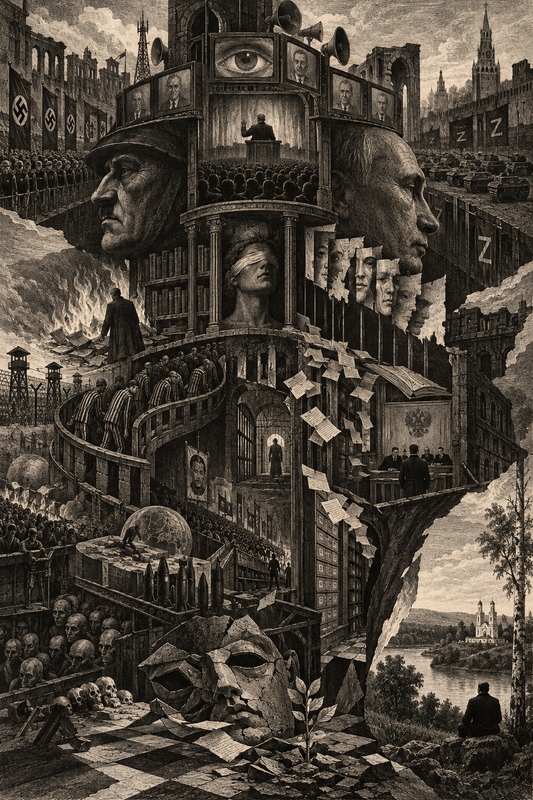
The Laboratory
Something monstrous happens here. The person ceases to be a subject of responsibility and becomes the bearer of a prescribed fate. They are no longer a participant in history but raw material for a historical or natural process. This is precisely why the camp in Arendt is not merely a place of detention and not even merely a factory of death. The camp is a laboratory. But the word "laboratory" must be understood in its most terrible sense. It is not a space of rational experiment in pursuit of knowledge. It is a place where it is tested how far one can go in the destruction of spontaneity, of personhood, of the inner form of a human being.
Totalitarian power is not satisfied by obedience. Every dictatorship knows obedience. It is not satisfied even by fear. Fear still assumes that the person remains inwardly themselves and simply feels afraid. Totalitarianism wants more. It wants the person to renounce their own inner reality. To acknowledge guilt they did not commit. To confirm not a truth but a schema. To themselves testify that their former personality never had any significance — or perhaps never existed at all.
This is why confession in a totalitarian system is not a legal act and not a form of proof. It is a ritual of ontological destruction. The old Bolsheviks who confessed to absurd crimes were not merely victims of violence. They became figures in a terrible experiment. They were made not only to capitulate but to participate in their own erasure. They publicly destroyed their biography, their meaning, their past. Their confession signified that reality was no longer determined by what had been, but by what power demanded. In this gesture one of the deepest essences of totalitarianism is revealed. It encroaches not only on the body and not only on freedom. It encroaches on the very connection between being and truth.
Not law restraining movement, but movement destroying all measure — and demanding ever new victims simply in order not to stop. This is one of the most bottomless thoughts in the entire analysis of totalitarianism. Such a system cannot stop, because stopping would be the moment of self-exposure. To stop would mean acknowledging that behind the continuous mobilisation, behind the purges, behind the enemies, behind the historical missions, behind the grand words — there was emptiness.
Therefore the movement must continue at any cost. It can change targets. First the real opponents. Then the suspicious ones. Then classes. Then peoples. Then the regime's own executioners. Then entirely new categories — so long as the energy of destruction is preserved. The enemy here is no longer discovered but produced. And this is precisely why purges become not an incidental episode but an internal law of the system. Today's accuser becomes tomorrow's accused. The executioner becomes the victim. And this is not a failure. This is the form.
The Law as Décor
This is particularly clear when one sees why the Soviet system could not genuinely examine Nazism as a totalitarian nature. It could examine it as an external enemy, as a different ideology, as a criminal regime. But it could not permit itself an analysis of the very logic of endless movement, because that would have required speaking of its own camps, its own purges, its own transformation of the human being into a cog, its own contempt for individuality. It would have been necessary to acknowledge that behind the loud anti-fascist gesture there lurked not an overcome but a reformatted totalitarian matrix.
The most important question here concerns law. Totalitarian regimes do not merely violate law. Tyrannies and military dictatorships and the despotisms of earlier centuries did that too. But totalitarianism goes a step further. It preserves law as decoration while simultaneously placing real force beyond its limits. Law remains in order to demonstrate its own impotence. The court remains in order to show that the decision is not made there. Constitutions, codes, procedures, speeches about justice continue to exist as façade. But their task is no longer to limit power — it is to give society the sensation of form amid the complete disappearance of content. This is one of the most terrible conditions of modern political existence. Not open arbitrariness, but arbitrariness dressed in the form of law.
The Mutation
It is precisely at this point that the historical theme begins to pass into the present day. Because the question is no longer whether the past is literally repeating itself. It is not repeating itself literally. It is mutating. And perhaps the most dangerous thing about contemporary forms of power lies exactly in the fact that they know how to exist not as classical totalitarianism, but as its hybrid, as its adaptation to the age of media, cynicism, simulation, atomisation, social exhaustion, and the erosion of language.
Russia provides difficult material for this. What is frightening here is not only that power is once again building itself through the external enemy, through the militarisation of consciousness, through the sacralisation of the state, through the designation of the guilty, through the blurring of the boundary between truth and propaganda. What is frightening is that all of this occurs under the sign of the Victory. Under the sign of anti-fascist memory. Under the sign of a sacred past that is being converted into an immunity against self-knowledge. And in this there is an almost demonic paradox. A system that defeated historical Nazism embedded that victory so deeply into its own legitimacy that it made it a cover for its own movement toward a new totalitarian mutation.
Therefore the question of who was worse — though it arises almost inevitably — leads in the wrong direction. It draws us back into the logic of comparing quantities, ideologies, scales, bodies. What matters here is something different. What matters is to see the principle itself. Not to measure evil, but to recognise the form that is capable of living inside different historical organisms. Nazism, Stalinism, contemporary hybrid authoritarian regimes do not coincide. They have different mythologies, different historical roles, different symbols, different levels of totality. But when at the centre stands not the human being but an abstract process, not truth but a schema, not law but will, not personhood but category, not memory but an instrument of mobilisation — then we are dealing with one and the same deep tendency: the displacement of the living in favour of the construction.
From this arises the terrible but logical image of the nuclear button. It is not only a question of geopolitics and not only a fear of a specific leader. The nuclear button becomes a philosophical symbol of the ultimate rupture between power and reality. As long as the connection with reality exists, there is an inner limit. The person still knows that there is a boundary after which action destroys not only the enemy but the very world in which action is possible. But the totalitarian form works precisely by destroying this connection. It isolates power from feedback, from shame, from responsibility, from measure, from the inner court. And then the possibility of an apocalyptic decision ceases to be pure fantasy. It becomes the logical extreme expression of a system that has grown accustomed to seeing in humanity its material, and in history not a living fabric but a field for the execution of an abstract mission.
The Artist's Task
This is, perhaps, the deepest tragedy of the twentieth and twenty-first centuries. We thought that the victory over the monster destroyed its essence. But the essence does not disappear along with the cut of the uniform, the emblem, the party name, the specific Führer or the specific Leader. It can migrate. It can change language. It can learn to speak in the name of peace, of truth, of memory, of tradition, of greatness, of security, of anti-fascism. And by doing so it becomes not weaker, but more cunning.
For me — as an artist, as a person of imagistic thought — a particular task opens here. Not merely to illustrate the horrors of history and not merely to moralise. The task is to make the form itself visible. To show not only victim and perpetrator, but the very mechanism that erases face, biography, inner spontaneity. To show the façade and the emptiness behind it. To show how law is converted into decoration, how memory is converted into a weapon, how victory is converted into an alibi, how the human being is converted into a reaction. And perhaps most importantly — to show the moment when evil ceases to be an external monster and becomes the principle of organisation of reality itself.
We were taught to see evil as an image. But an image can be hung on a wall, condemned, destroyed, replaced by another image. It is far more difficult to see that evil can be a form. A form of power, a form of thought, a form of language, a form of social organisation, a form of historical memory. And precisely for this reason it is so dangerous. It does not always shout. Sometimes it speaks with the voice of the victor. Sometimes with the voice of order. Sometimes with the voice of law. Sometimes even with the voice of salvation.
Where Genuine Study Begins
This is why genuine study of history begins not at the point where we have learned to correctly condemn the enemy, but at the point where we have gathered the courage to see similarity where we were taught to see only difference. Not in order to cancel the Victory. Not in order to equate everything with everything. But in order finally to understand that victory over one form of evil does not guarantee freedom from its nature. Sometimes, if this nature goes unrecognised, the victor themselves becomes its new body.
And perhaps the most unsettling lesson here lies in exactly this. The monster does not always come from outside. Sometimes it grows within the triumphant memory of how we already defeated it once.