Heir by Direct Line
History does not repeat itself literally. It repeats itself structurally. Not in scale, but in mechanism. Not in costumes, but in logic. And if this logic goes unrecognised, it always returns under a new name.
This text does not claim that Putin is Hitler.
It does not claim that Russia is the Third Reich 2.0.
It does not claim that current Russian repression equals Nazi repression in scale.
Anyone who argues with precisely these points will be arguing not with this text but with their own convenient strawman.
The concern is something else. Not an accusation. A diagnosis.
Control over the Narrative
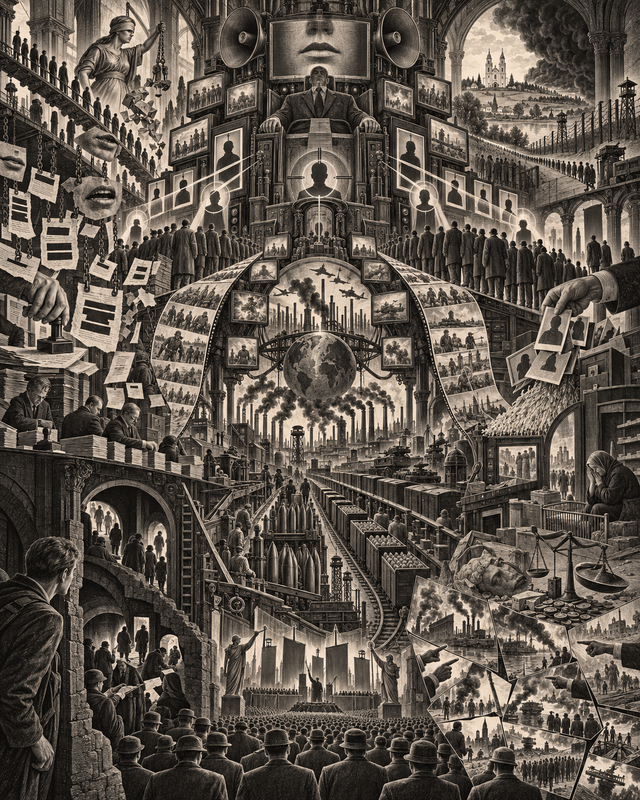
Goebbels in 1933 carried out Gleichschaltung — the alignment of media into a single chain. Newspapers, radio, cinema, theatre, publishing houses. Pluralism was destroyed quickly, crudely and openly.
Putin did the same thing differently. More slowly. More subtly. Through owners, courts, debts, laws and "foreign agents." NTV was the signal. Everything that followed became routine.
This is not 1933. But the principle is the same: the state must control not merely the news but the image of reality that the citizen sees.
The difference is not in the intention. The difference is in the technological environment. Goebbels did not have Telegram and VPN.
The Enemy as Architectural Necessity
Any regime of this type requires an enemy not as an accidental object of hatred but as a load-bearing element of the structure.
The Nazis needed Jews, Communists, "degenerates." Not because they could genuinely destroy the Reich, but because without an external enemy the internal ugliness of power becomes too visible.
Nazism required an ontological enemy — the Jew, the Romani, the Slav as Untermensch. The enemy was defined by blood and birth.
The contemporary Russian system made a more "effective" move — effective, that is, from the point of view of regime survival: here the enemy is functional. It is the traitor. One can become a traitor at any moment, regardless of origin, for a single post, a single bank transfer, a single glance.
This is not the weakness of the system, as the Nazis had with their rigid racial theory, but its flexibility. The enemy is always nearby. The enemy carries no anthropological markers. The enemy is indistinguishable from the "normal" citizen. This creates the total suspicion that Arendt considered the main pillar of totalitarian movements, even when the state itself has not yet become fully totalitarian.
The Putin system operates on the same principle. The list shifts over time:
- Chechen terrorists
- Orange revolutions
- Ukrainian Nazis
- LGBT people
- "Foreign agents"
- The collective West
Yes, Ukraine is real. NATO is real. Sanctions are real. But that is not the question. The question is the moment when an external threat becomes a universal justification for internal cleansing.
Historians, sociologists, journalists, human rights defenders did not shell Belgorod. But it was they who were eliminated.
Which means the matter was not the security of the country. The matter was the security of the regime from its own society.
The Criminalisation of Language
The Nazi Heimtückegesetz made it a crime to utter words that undermined trust in the state. A joke, a letter, a private conversation could become the basis for prosecution.
Russia's Article 207.3 operates more mildly in scale, but follows a similar logic. What becomes a crime is not violence, not conspiracy and not slander, but deviation from the official language.
The very word "war" may be more severely punishable than a lie. This is the most important symptom.
The Destruction of Memory
The Nazis burned books in public squares. Contemporary regimes prefer to be tidier. They dislike smoke. They prefer protocol.
Therefore today memory is liquidated through the courts, through archival locks, through "foreign agent" status, through the closure of institutions, through legal suffocation.
Memorial was dangerous not because it worked for the West. It was dangerous because it worked with memory.
And a power that builds its legitimacy on Soviet revanchism cannot permit the systematic documentation of the price of Soviet history.
The War Economy
By the late 1930s Nazi Germany was driving itself ever deeper into the trap of war production. War was becoming not only an ideology but a way of sustaining the whole construction.
Russia is not Germany in 1939. It has oil, Asia, external markets, room to manoeuvre.
But the trap is recognisable. When the economy adjusts itself ever more completely to war, it becomes ever harder to stop the war — not only politically, but structurally.
A shell increases GDP. It does not increase welfare.
Censorship as a School of Circumvention
The USSR jammed Western radio for forty years. The result is well known: people listened even more attentively.
In contemporary Russia the blocks played a similar role. Instead of complete isolation they created a mass habit of circumventing restrictions.
Ineffective censorship does not defeat information. It produces people who learn to seek out what is forbidden.
And this is particularly ironic: a power that fears free access to reality is itself training citizens in the technique of escaping control.
Social Cohesion as Anaesthetic
Fromm explained this long ago: a society that has lived through trauma and collapse seeks authoritarian fusion. Freedom is too unsettling. The collective body soothes.
Russia experienced the collapse of the USSR as precisely such a trauma. Hence the skrepy — the "staples" — the traditional values, the special path, the "we are not like the West."
Weimar suffered from humiliation — Versailles — and hyperinflation. The Russia of the 1990s lived through not merely defeat in the Cold War but the devaluation of subjectivity itself. A person who under the USSR was part of an "empire" suddenly found themselves impoverished, redundant, deceived.
The Putin system offered not simply "order" but the return of agency through the collective humiliation of others. The logic of "no one will touch us" and "we are strong" functions as psychotherapy for the post-traumatic syndrome of an entire society.
As long as this trauma remains unworked — and power constantly reactivates it — the structural repetition of authoritarian patterns will continue to find an emotional resonance.
Relativisation as a Form of Defence
The common reflex runs as follows: "But what about Iraq." "But what about Libya." "But what about colonialism." "But what about double standards."
Yes, all of that happened. Yes, international law has been violated in places other than Moscow.
But none of these facts alters the nature of this specific Russian aggression. Other people's crimes do not provide an alibi for one's own.
The System's Main Weakness
Putin is not in a bunker in 1945. There is no collapsing front. There is no final act of catastrophe.
But there is something that for any authoritarian system is lethal: a growing gap between the official narrative and everyday experience.
- Obituaries appear faster than victory dispatches
- Inflation argues with the television
- Regional budgets argue with imperial rhetoric
- Military mobilisation of the economy argues with stories of stability
The system still holds. But it holds increasingly by managing the description of reality instead of reality itself.
And that is always a bad sign.
The Soviet Union did not collapse because it suddenly weakened physically. It collapsed because millions of people stopped connecting the official language with their own lives.
There are two convenient errors.
The first: to simplify everything and say that we are looking at a direct repetition of the Third Reich. This gives emotional satisfaction but makes thought crude.
The second: to blur everything and say that this is simply one autocracy among many, nothing special, ordinary geopolitics. This sounds academic, but it too conceals the mechanism.
The truth lies between these two conveniences.
What we have is a hybrid authoritarianism that reproduces well-known historical patterns: control over the narrative, production of the enemy, criminalisation of language, destruction of memory, the overheating of the economy by war, the dismantling of institutions of resistance. These patterns do not need death camps to be dangerous. They only need time. And the absence of forces capable of stopping them. Russia has been moving toward this for twenty-five years.
Therefore the main question is not whether "it is the same thing" or "not the same thing." The main question is different: what logic is being reproduced here, and where does it lead if it is not interrupted.
The parallels in mechanisms are real and troubling. But the differences are no less significant and cannot be smoothed over. Nazi Germany after 1933 moved toward total ideological restructuring of society, biological racism as the foundation of policy, and full-scale war for Lebensraum within a relatively short time window. Repression there rapidly reached mass scale — hundreds of thousands already by the mid-1930s, then millions.
Contemporary Russia is a hybrid wartime authoritarianism with a strong corrupt and security-apparatus component. Ideology here is secondary to the preservation of power. According to independent monitors — OVD-Info, Memorial and others — the number of political prisoners at the end of 2025 is estimated at several thousand: by various assessments, between 800–1,200 recognised political prisoners and up to 4–5 thousand in the broader understanding of politically motivated prosecution. This is a grave and impermissible number for any country claiming civilised status, but it remains orders of magnitude below Nazi Germany's figures already by 1938–1939.
The Putin regime evolved slowly, over 25 years, combining repression with elements of private life, consumer society and corrupt "safety valves." This makes it more stable in the short term, but more vulnerable to internal decomposition once the official narrative finally ceases to correspond to the reality of millions of people.
History rhymes not only with 1933. Authoritarian and totalitarian patterns have repeated in different forms in Stalin's USSR, Maoist China, and other dictatorships of the twentieth and twenty-first centuries. Comparison exclusively with Nazism is emotionally powerful, but risks narrowing the understanding. The danger lies not in "the repetition of the Third Reich" but in the gradual degradation of institutions, in which society loses the capacity to resist the arbitrariness of power, regardless of under what flag and with what slogans this occurs.
The main lesson of Arendt, Fromm and the other thinkers cited in this text consists not in the search for an exact historical double, but in the recognition of the logic: when power begins to govern not reality but its description; when the enemy becomes a necessary element of internal legitimacy; when memory and language are subordinated to political expediency.
If this logic is not interrupted — through institutions, civic courage, independent thought and international pressure where it is possible — it is genuinely capable of leading to ever heavier consequences. But the exaggeration of analogies is as harmful as their complete denial: the first pushes toward hysteria and the loss of nuance, the second toward self-reassurance.
Diagnosis must remain honest in both directions. Only then does it remain useful.
Arendt, Fromm, Speer — are available to everyone. Parallels in mechanisms, not in scale. The rest is a question of honesty of vision.
Aglona
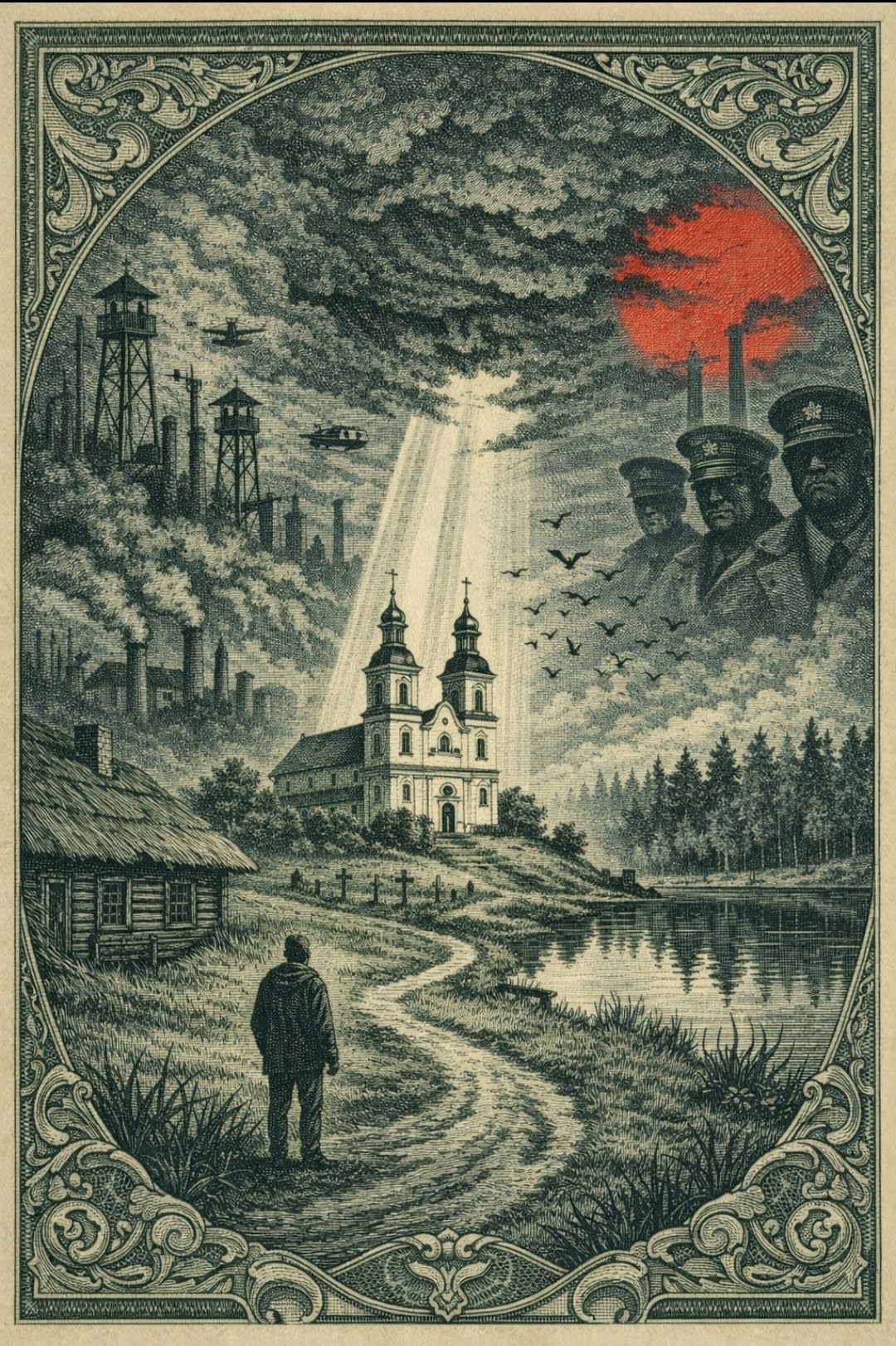
I feel it as a lump in the throat — a foreboding, tense, almost animal. Every year, returning to my Aglona in Latgale, I notice how the air on the other side of the border, in Russia, grows heavier. Not a sudden catastrophe, but a slow change of atmosphere: in the words people now carefully weigh, in the silences that grow more habitual than any conversation, in the way yesterday's unthinkable gradually becomes simply "life."
We have already lived once in such a space — in the Soviet Union, where fear and the official picture of the world blended into one heavy mixture. Now what is returning is not an exact copy, but something more cynical: less genuine ideology, more naked retention of power. Repression has not become mass-scale as in the old days, but has become targeted and hard — according to Memorial and OVD-Info, by the beginning of 2026 the number of recognised political prisoners exceeded twelve hundred, and those deprived of freedom on politically motivated charges stands at around five thousand. The system is learning to work more quietly, more calculatedly, but more deeply.
And nearby, here in Latvia, I see how the same mechanisms try to work across the border: a hybrid spectacle with propaganda, talk of "protecting compatriots," attempts to reheat the old fractures between Russian-speakers and Latvians. Russia casts a shadow over Latgale, over my small Aglona — with its basilica, its stillness, and the memory of ancestors. I do not want it ever to become a playing card in this game. Neither in the guise of the "Russian world" nor in any other guise.
I return every year to an already relatively free country — and to one that is the complete opposite of the country that borders it and carries within it the heavy legacy of the Soviet Union. Formally I now live far away and in safety. But my sense of self remains there, where I come from. I do not want a day to come when I can no longer turn quietly toward my Aglona, my place, because the air there has finally become foreign.
This is not merely politics. It is a change in the very air that breathes through a space. When you return "home" and suddenly catch yourself beginning to grow accustomed to new forbidden subjects, to people saying one thing while thinking another — or having already stopped thinking at all — then true despair arrives. Not from the fact that "things are bad," but from the fact that "bad" is becoming invisible.
That is why I write. Not to pronounce a verdict or find an exact historical double. But in order not to surrender myself. To preserve inside myself that gaze which still distinguishes where politics ends and where the slow poisoning of the air begins. As long as this lump in the throat remains, it means I am still breathing my own air. Not theirs.
I do not want to arrive in Aglona one day and catch myself thinking that I have already accepted this new "norm." As long as I feel the tension — I resist. And I will write, think, remember. So that the darkness I already sense never becomes simply the air that is breathed without resistance.