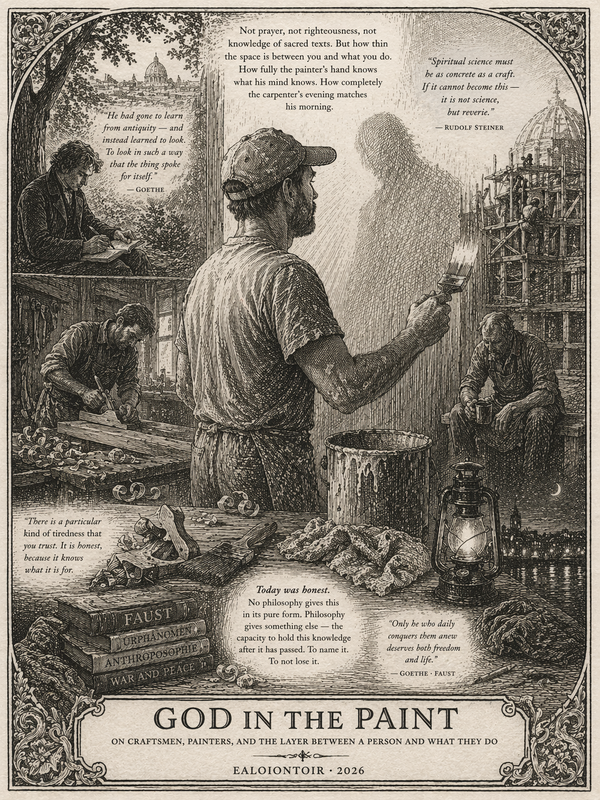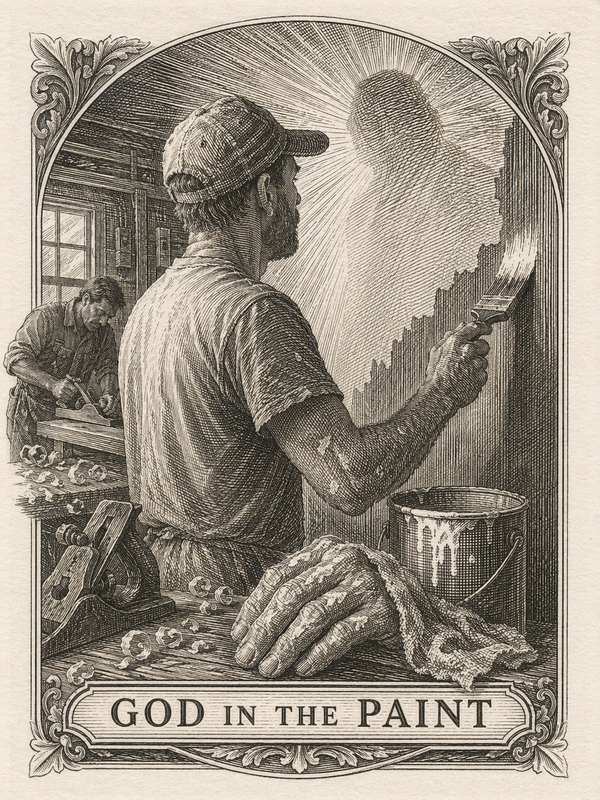
Nobody explained to the painter what presence means.
He arrived in the morning, picked up his brush, and began. The wall in front of him was real — not a metaphor for a wall, not a concept of surface, not an occasion for reflection on the boundary between interior and exterior. Just a wall that needed painting before dark.
There is something impenetrable in that simplicity.
There is a particular kind of tiredness that you trust.
Not the tiredness that comes at the end of a long day of thinking — diffuse, without a clear address, slightly shameful. But the kind that lives in specific places: in the painter's forearm, in the carpenter's neck, in the craftsman's palms. It is honest, because it knows what it is for. It does not ask whether the day was real. It simply is — as proof.
Philosophy cannot do this. It always suspects itself a little.
Tolstoy described this without naming it.
A dying official, a life lived correctly and wrongly at once, lies in pain and pretence. And the only person beside him without performance is a simple peasant boy who empties the chamber pot and finds nothing degrading in it. Not because he is especially virtuous. But because between him and the situation there is no layer.
That layer — that is what separates us from God. Not sin, not ignorance, not pride in its classical sense. Simply a layer. Interpretation between oneself and the thing. Commentary between the hand and the act.
The carpenter lives thinner than that layer. The painter thinner still. The craftsman who knows his trade — often without it entirely.
Goethe understood this before a sun-warmed wall in Rome.
He had gone to learn from antiquity — and instead learned to look. To look in such a way that the thing spoke for itself, rather than you speaking about it. He called it Urphänomen — the primal phenomenon, the archetypal form. But that word came later. First there was just a wall. Just light on stone. Just something that became clear without effort.
The stonemason who laid that wall perhaps knew this better than Goethe. He simply had no words for it — and needed none.