Gerard The sunshine is just coming out
A twenty-eight second recording of a Dublin poet, and the long way an image travelled from it. Spirit of Time archive, 2020 to 2026.
The whole movement, from a voice under a tree to the light he named. Choose a star to go there.
Twenty-eight seconds
There is a recording that lasts twenty-eight seconds. On its cover frame an older bearded man stands beneath the branches of a tree. His eyes are closed. Light falls on his face.
Press play and a whole city rises out of those seconds. Dublin in the first autumn of the pandemic. Closed cafés. A park without visitors. A camera in the hands of a mature student who does not yet know why he has come.
Proust described this better than anyone. A crumb of cake dissolving in tea raises all of Combray, its streets, its church, its gardens. Memory does not come when it is called. It comes through an object that happens to be near. Here the object is a voice.
There is one difference, and this whole page stands on it. Combray belonged to the narrator. This voice belongs to someone else. What rises from the twenty-eight seconds is not only the artist’s morning. It is Gerard’s morning. The archive keeps both, and does not hand one over to the other.
The empty city
Autumn 2020. COVID has closed Dublin. The streets stand without people, like a stage after the play.
The artist is forty-three or forty-four. He has lived in Ireland for twenty years and has just begun Fine Art at NCAD. He is an adult among the young. He carries a pressure he later describes simply. Something had to be pulled out of himself. There was not yet any language for it.
An empty city shows people a full city hides. When the crowd is gone, the ones who have nowhere to go remain. The street stops being a passage and becomes a place where someone lives.
The subject he did not want
He wanted to begin with landscapes. It was an honest wish. A beautiful surface, visual art without deep immersion. A landscape does not look back.
For his first project he chose something else. Portraits of people without homes and of people living with addiction. He did not want the subject. Every early version of the story stresses this. He chose it because he did not want it. The path began with an assignment and a reluctance, not with a revelation. Everything later called fate grew out of a refusal that was overcome.
The wording of the NCAD assignment is not held in the archive.
Under the tree, St Stephen’s Green
With the camera he went into St Stephen’s Green. There he met an older bearded man who introduced himself as a poet and a musician. In the captions of that time his name is written Jerard. Later archive texts write Gerard. How he spells it himself is not known.
Gerard agreed to be photographed and filmed for the portrait project that day. He was offered ten euro. That detail survives in only one source, a raw spoken account that dates itself to August 2024 and was uploaded in November of that year. The polished English version made that same August no longer has it. Later essays lost it too. Each new version made the story cleaner and let the note fall out.
The archive puts it back. Ten euro was part of the agreement, and it also shows plainly where two people stood. One held the camera and chose. The other lived on the street and agreed. Without the note the meeting reads like grace. With it, it stays a meeting of two people in unequal circumstances that still became something larger.
On the surviving frame he stands beneath the branches with his eyes closed. People do not pose like that for a social photograph. That is how someone reads from memory, listening to his own text.
His voice
This is what he reads in the recording, kept exactly as transcribed. Its roughness belongs to the document.
Who are we, as homeless people?
A lost belonging, for understanding, for everything and anything.
Birds, the bees, the trees, the rust,
the wind flowing in my face,
the rain dripping on my head.
The sunshine is just coming out.
It’s beautiful to wake up in the morning
to experience the beauty of gratitude
for waking up.
The question is asked in the name of a category. The answer does not come from one. He does not describe himself. He describes what reaches him. Birds, bees, trees. Wind in the face. Rain on the head. Light coming out. A man without a roof is the man to whom the weather happens directly. Nothing stands between his head and the rain. In this poem the missing roof becomes a way of perceiving.
The line about the sunshine is first of all a report. Someone outdoors notices the light changing. Before it means anything else, it means that. It is not a halo and the archive does not read it as one.
The ending is simpler than everything before it. He woke up, and he is grateful for it. The most elementary fact of being alive is named as a gift.
Grafton Street
Other people came up to them. The accounts differ on how many there were and how many were photographed. Then they all walked out of the park together onto Grafton Street.
The reaction came after the filming, and it was not expected. Tears. A bodily sense that someone else’s pain had come in and stayed. A wish to leave the city centre quickly.
In Proust the body remembers before the mind. An uneven paving stone in a courtyard returns Venice, which no effort of will could summon. Here the order is earlier and reversed. The body took in what the mind had not yet named. Naming would take years.
In the early account the artist says honestly what he had seen before the meeting, an outer shell that repelled him. After the meeting the shell stopped working. In front of him were no longer the homeless as a theme for a project. They were ordinary people in hard circumstances.
The archive later named this an ethical threshold. It is an event after which the old distance between the one who observes and the one observed no longer holds. The term describes a change in the artist. It makes no claim about what Gerard felt.
The first public face
On 11 December 2020 the artist published the first post on his Instagram. The very first. It was of Gerard.
A public life in art began with another man’s face. That is not a biographical detail. It is its first sentence.
Two texts about one head stand side by side. The caption speaks of the roof everyone needs. The poem speaks of rain dripping on his head. One demands and the other perceives. The social voice of the artist and the poetic voice of the man he photographed sound at the same time and do not coincide. That pair stays in the series for a long time.
The caption speaks of addiction. Those are the artist’s words and the project’s theme. Whether they describe Gerard himself, the archive does not establish. The number in the last hashtag is unexplained. On 14 January 2021 the voice appeared on YouTube. The upload date is not the filming date. The meeting took place no later than 11 December 2020.
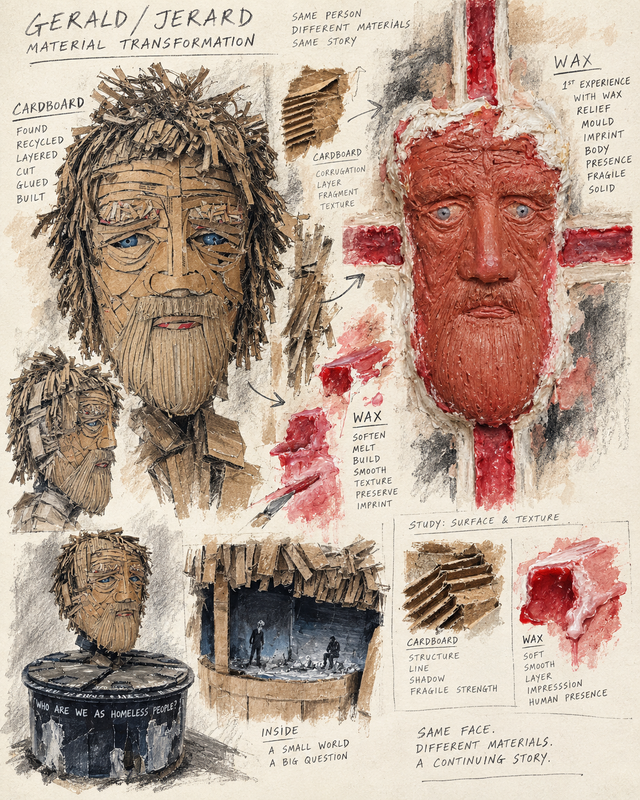
Cardboard, and the word FRAGILE
From here meaning began to pass from material to material. The archive calls it a relay of materials. Each carrier added a property of its own. The photograph held the face. The video held the voice.
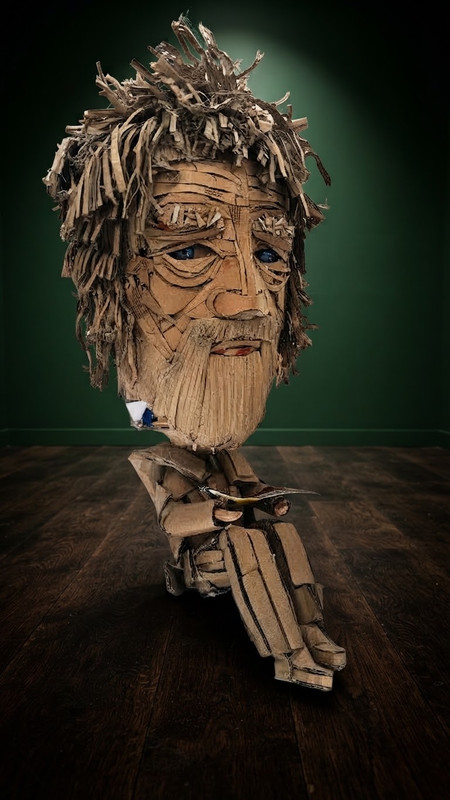
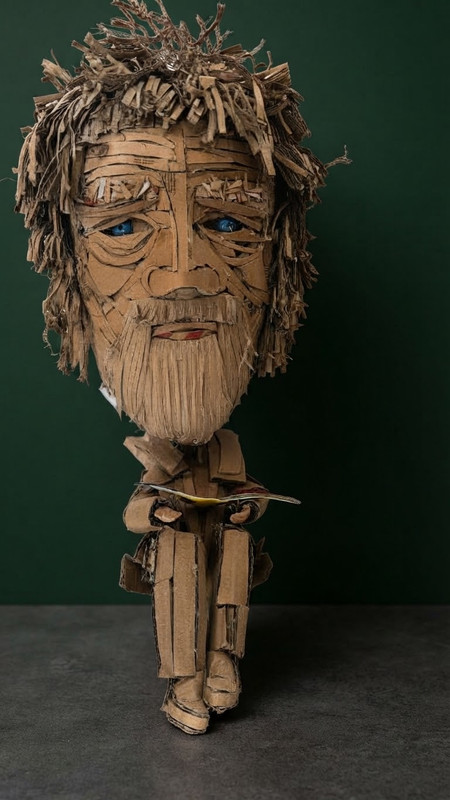
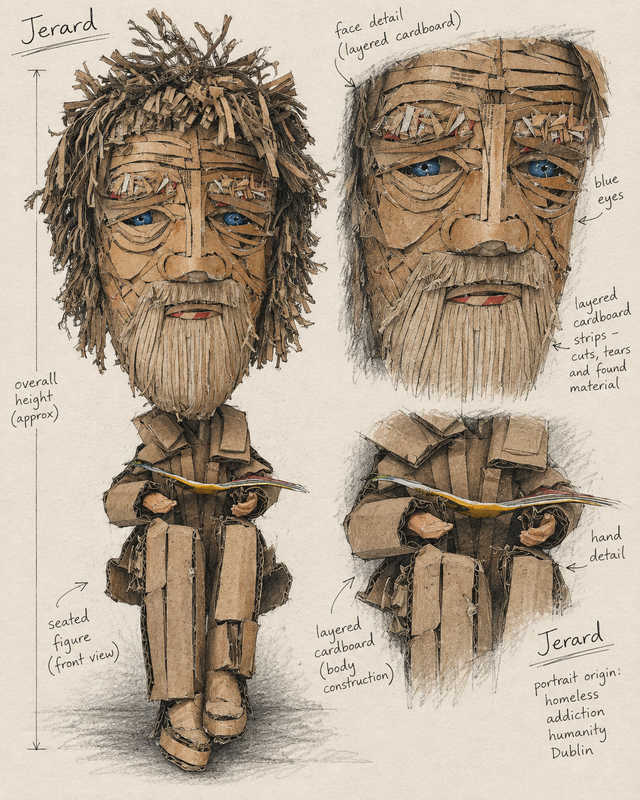
Then came cardboard. It is the material of the city’s discards, the boxes that carry goods and the boxes people sleep in. The word FRAGILE was on it. The exact inscription has not yet been checked against a photograph of the work.
Cardboard has a language of its own, the language of packaging, instructions for handling what can break. That language returns in a neighbouring work of the same year.
A figure in Gerard’s image grew out of the cardboard. It was built rather than modelled. Strips were cut, torn, layered and repeated until a face and a body came out. The unevenness is part of who it is.
Two chambers behind the face
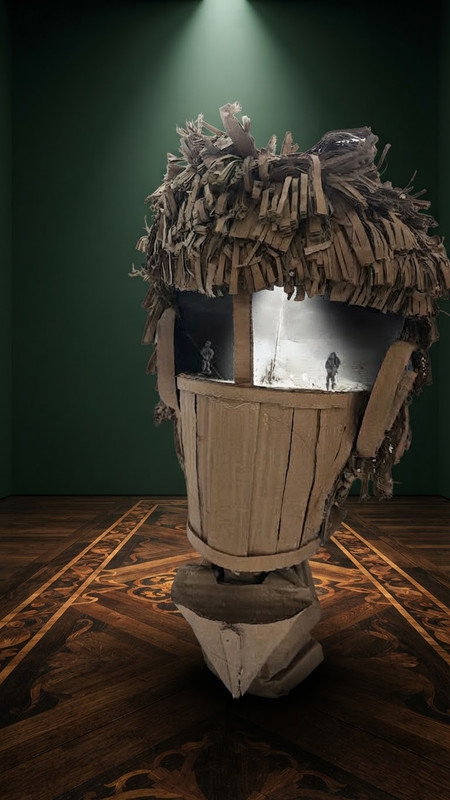
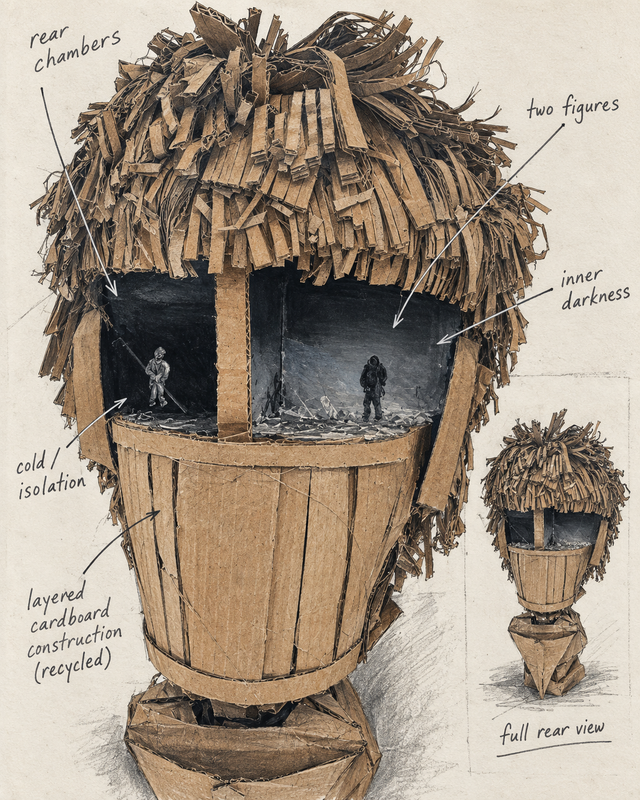
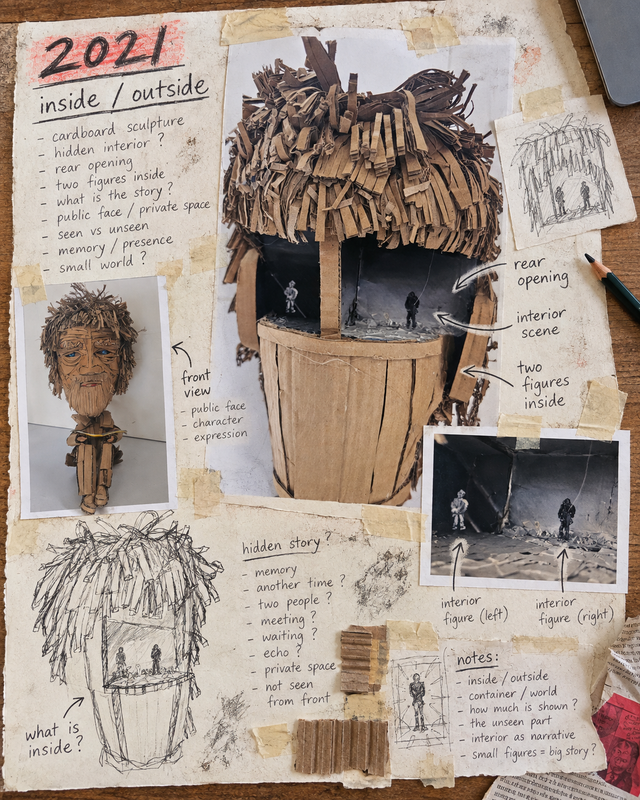
At the back of the head the artist made two separate dark spaces. In each stands a solitary human figure.
The first content was social. Winter, cold, darkness, loneliness. Dark and light. In May 2025 the artist insisted on exactly this. The chambers first spoke about the city and a person’s place in it.
The figure sat on a cardboard circle. A man of cardboard on cardboard ground. Everything he had was made of the same material as himself.
Wax
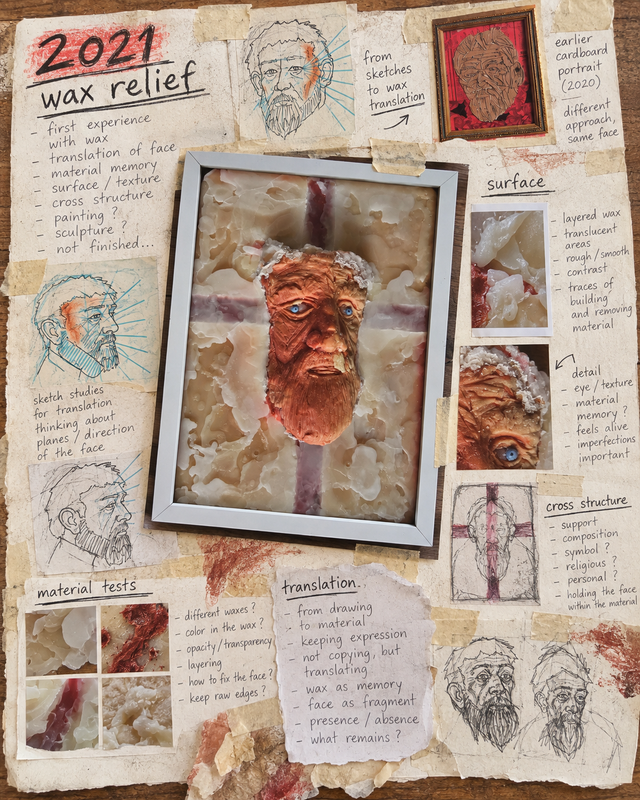
Screenshots from 11 January 2021 show the next layer. Gerard’s face in wax, as a relief, captioned 1st experience with wax. NCAD and Christ Church Cathedral appear in the same set.
Wax moved the face into another state. Cardboard is fragile. Wax is soft. It remembers touch and melts in warmth. The face became a surface of memory.
Today the relief is a bearded face on a pale field marked with a cross, in a white frame. In a photograph from December 2025 a book about Jung lies beneath it. The book belongs to a later time. The meaning of the cross also came later and still needs its own date. The object keeps an early gesture, and what surrounds it shows a later reading.
The mirror
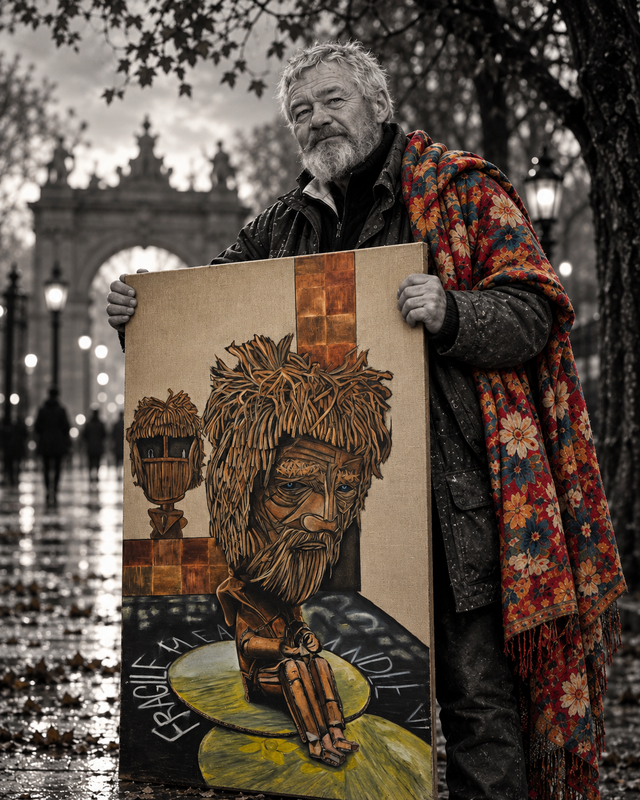
Then came an oil painting. The cardboard figure sits on its cardboard circle. Beside it stands a vintage mirror, bought by chance. The mirror reflects the back of the head with its two chambers.
There are three degrees of reflection here. The man in the park. His cardboard double. A painting of the double, in which the mirror shows what cannot be seen from the front.
The mirror appears again in the artist’s work. In the 2022 painting Transformation / Threat the archive finds a tension between a mirror and a phone. The motif crosses works. It is not a chance purchase that worked once. It is a device the hand kept returning to.
The mirror painting has not been dated.
The red fragment
A triangle of red acrylic broke off another, red painting. The artist placed it in the figure’s hands without thinking. There was no plan.
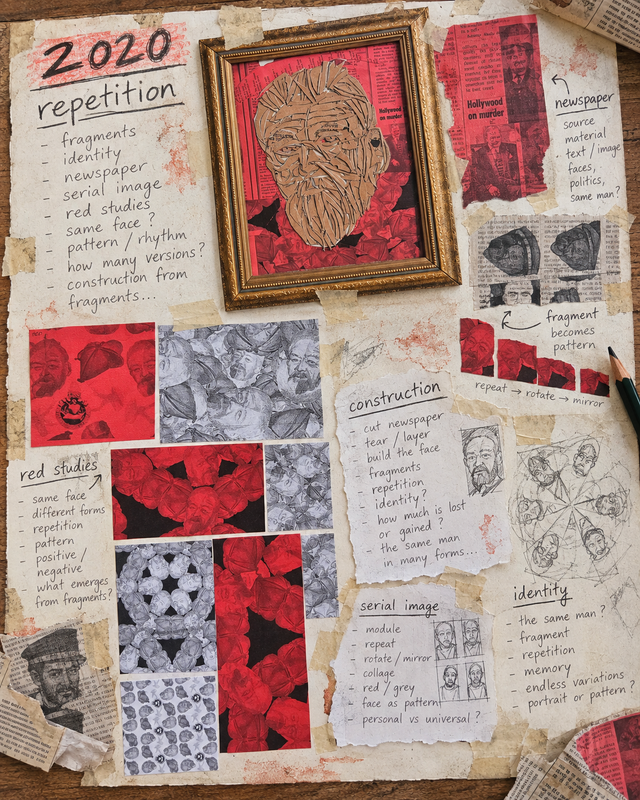
The gesture has a second side. Somewhere there is a red painting missing a piece. Its absence lives in Gerard’s hands. Two works are joined by a wound. The archive calls this a negative archive, a work that holds its history through what is missing from it.
The hands did it before the mind asked why. In Proust involuntary memory arrives on its own. Here an involuntary gesture arrived. Its meaning would open only years later.
How Freud entered, and what followed
Nobody set out to make Freud. Near the end of the course a teacher remarked that the cardboard figure resembled him. By the artist’s later account it was the teacher who named the likeness first. In an account from January 2025 the artist says he sees it himself. Who saw it first still rests on memory.
That remark is the hinge of the whole later story. Once the figure had a psychoanalytic face, its parts began to be read in that language.
After Freud came Jung. The two chambers were read as the conscious and the unconscious, the personal and the collective. The red fragment in the hands was read as Jung’s Red Book. Gerard reading the Red Book.
All of this came afterwards. The order matters more than the content. First cold and loneliness. Then Freud from outside. Then Jung from within. The image was made before its meaning. The work knew more than its maker, or the maker later found more in it than he had put there. The archive does not choose between these. It records the order in which things happened.
The course ended with a graduate show after three years. Its catalogue, photographs and date have not been found. The teacher’s name is not recorded.
The brush stops
In Proust the narrator understands only at the very end that he must write. The vocation arrives in the finale, after the whole life.
Here it went the other way. The easy vocation ended at the very beginning. After Gerard, art stopped being aesthetics. Painting stopped. The brush does not lift just like that. Falseness is felt at once.
The artist still finds it hard to call himself an artist in the ordinary sense. That is the most direct consequence of the meeting, and there is nothing mystical in it. The threshold did not hand him a finished teaching. It made the old way of working insufficient.
Three and a half years of silence
Between January 2021 and August 2024 the archive has found no account of Gerard in words. Whether conversations from 2022 or 2023 exist is still unknown.
If the silence holds, its meaning is clear. For three and a half years the meeting lived in materials rather than in speech. In cardboard, wax and a mirror. In Proust most of a life passes in forgetting, until chance raises it again. Here the chance was a new kind of interlocutor, which arrived in 2024.
Many Gerards
In Proust Albertine breaks into many Albertines. Every meeting, every rumour and every memory makes a new one, and the real one stays out of reach. The same happened with Gerard. Over six years different voices told him, and each left its own version.
Each star is one telling. The warm one at the centre is the only telling that is his own. Drag to turn the constellation, or choose a telling.
At the end of Time Regained the narrator arrives at a reception and cannot recognise the guests. Everyone has aged. Everyone seems to wear a mask. It is the same here. Each version of Gerard has been aged by its teller. Under all the masks stands one man under a tree, whom none of the tellers saw again.
The machine looks at the back of the head
The oil painting showed the back of the head through a mirror. Three years later the same back of the head was shown to a machine, with a question about what was inside.
In June 2026 an essay read the mirror as a forerunner of AI. But the literal act had happened two years before that reading. On 24 August 2024 the image of the two chambers really was sent to a machine with a question.
This is a rhyme, not a prophecy. The difference in it matters more than the likeness. The mirror in the painting only shows. The machine answers. And it was a machine that first added the Sage. A mirror that can speak returns not only a reflection but an interpretation. The archive has been working with that ever since.
The pendulum
The chronology of tellings has a shape. It is not a straight line. It is a pendulum.
The first wave, in 2024, inflated. A Sage, the Goetheanum, Steiner. By the surviving traces a machine named the archetype first, and a polished English text assembled the whole chain. That chain was tempting because it tied Gerard to another line in the archive, the Alpine dream that leads to Rothko and to the Goetheanum. Through Jung, a man in a Dublin park was suddenly connected to Dornach.
Then the pendulum swung back. In May 2025 the artist himself returned chance and empathy. In 2026 the archive returned the ten euro, the voice and a ban on the Sage.
The movement repeats the meeting itself. First the man was a category. Then he became a voice. Then an archetype. Now he is becoming a voice again. Each time he has to be rescued from what has already been said about him.
What connected to what
Every point of this story touches others. Some joins are material, one object made out of another. Some are later readings. Some are rhymes, noticed long after, that prove nothing. Choose a point to see its joins.
personvoiceimagesymbolperson again
how it was builtwhat it containswhat it became
Neighbours, not evidence
Other events of the same period stand around Gerard. The archive does not fold them into his chapter. Otherwise a human meeting turns into a container for every coincidence. They are neighbours here, not part of his story.
Daffodils
In the same study period the artist made a work with daffodils on cardboard, with a globe and a phrase from packaging. Its exact wording is unchecked, handle with care or Please handle this care. The next day he learned about Daffodil Day, the cancer charity day he had not known of. The joint is material. FRAGILE on Gerard’s figure, handle with care on the daffodils. In one year the instructions for fragile freight appeared twice on works about fragile life. That is an observation about material, not about fate.
Dorset Street
An empathic frame, a return to a place, a meeting with a man from the past. The archive calls it a bodily relay.
The Alpine dream
An inner image, a sketch, and recognitions that arrived later and in pieces. Its line runs to Rothko and the Goetheanum.
Transformation / Threat
A painting that gained historical meaning after it was finished. A mirror and a phone. A painted-over train as a negative archive.
Joyce’s Dublin
An essay of June 2026 turns St Stephen’s Green, Grafton Street and NCAD into islands of the artist’s own Dublin odyssey. Gerard’s park and his street stand among them.
Together they show different ways a beginning can happen. Gerard is the only one among them where the beginning was another person. A dream comes from inside. A painting receives its meaning from history. Gerard came from outside, with his own voice, and that voice does not belong to the artist.
A little patch of yellow wall
In Proust the writer Bergotte dies in front of Vermeer’s View of Delft. He has come to the museum for one detail, a small patch of yellow wall. Before he dies he understands that he wrote too dryly. He should have laid colour on colour, like that patch.
In September 2026 an ear heard the line The sunshine is just coming out for the first time as a line. A proposal for the first painting of the archive grew out of it. GERARD, THE SUNSHINE IS JUST COMING OUT.
Almost monochrome. Payne’s grey, umber, white. Blurred, with part of the information lost, like an old photograph. Somewhere light touches the man, the edge of the face, a hand or a nearby wall. Only there does a little living warm colour appear. Not a halo. Not a symbol. Physical sunlight.
That is the patch of yellow wall. Only this time the painter did not choose the colour. It was taken from the words of the man in the painting.
Colour has entered the series once before. The red triangle came from another painting by an accidental chip, and its meaning came from the artist’s later reading. The sunlight comes from Gerard’s own speech. If this painting is made, the colour in the series will for the first time belong to the one portrayed.
On the cover frame of the 2021 recording the light already lies on his face. It was in the frame from the start. It took five years to read it.
Birds
Birds have appeared in the canvas the artist is painting now. The first word in Gerard’s list is Birds.
This is a rhyme found years later. It is not proof. It is kept apart from the primary document of his voice, with the date it was noticed. Perhaps the birds came into the painting much earlier than anyone understood where they came from. Perhaps it is a coincidence between a man who loves the sky and a man who lives under it. The archive does not decide.
Imagined returns
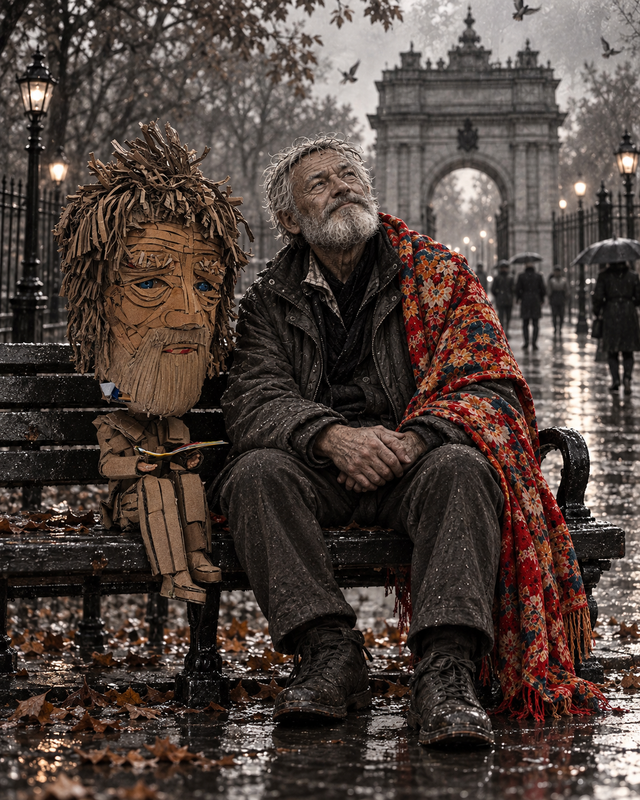
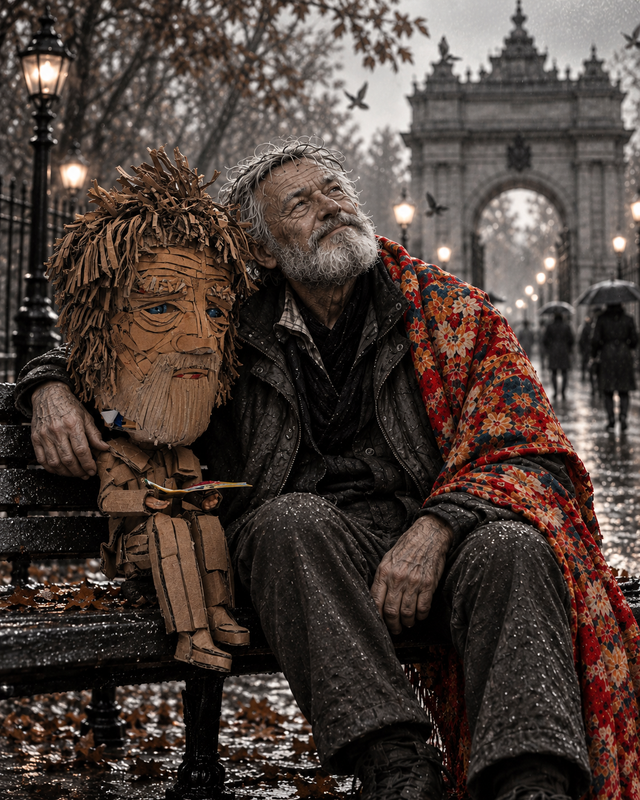
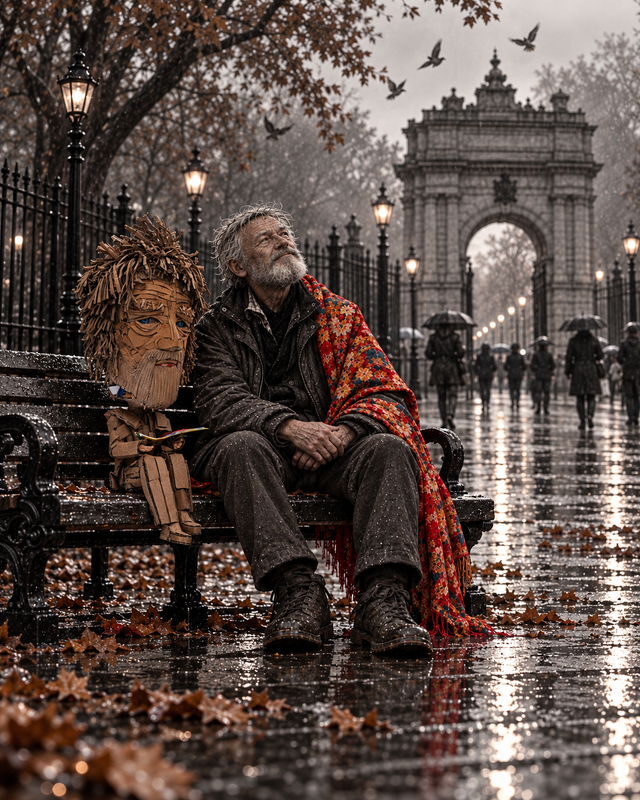
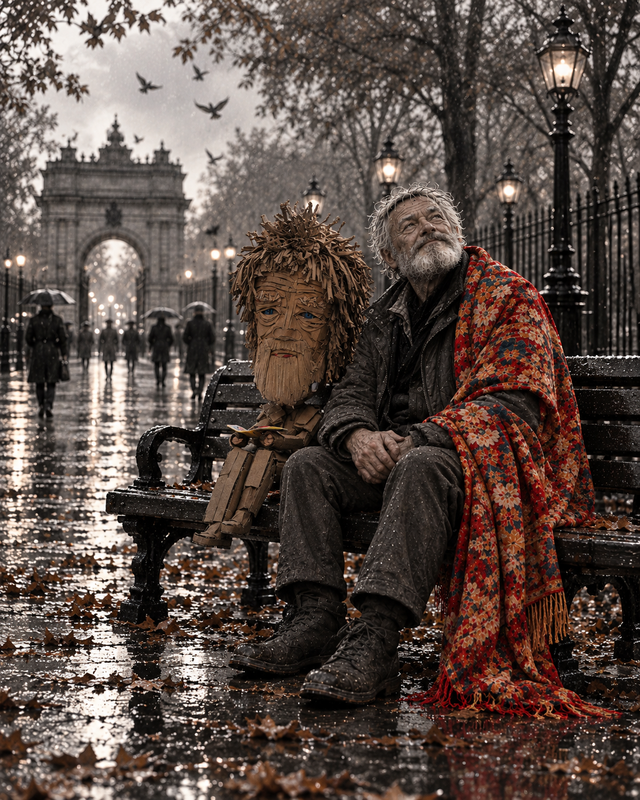
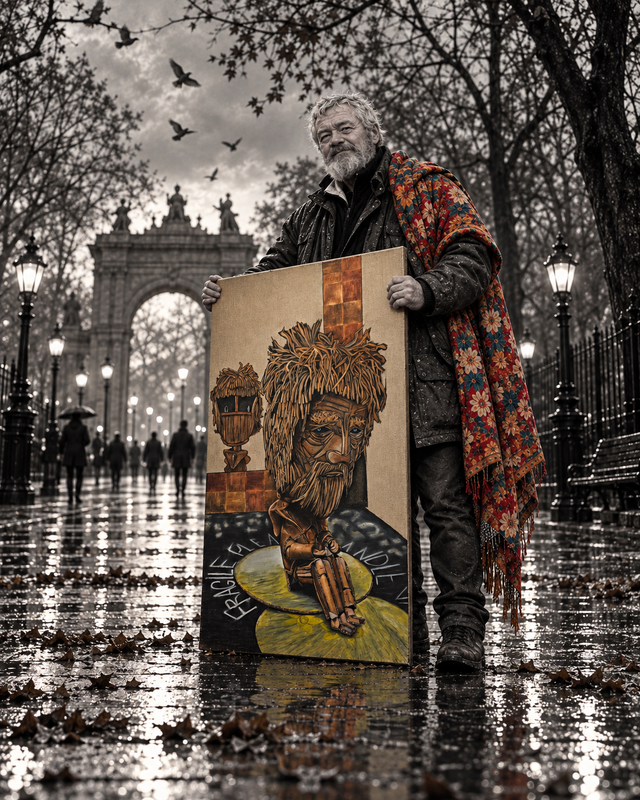
These images were made in 2026. They imagine scenes that never took place. Gerard sits beside his cardboard double and holds a painting made after him, They are kept here, apart from the record, so they are not mistaken for it.
What remains his
Gerard agreed to the portraits that day. The archive keeps the rest of what it knows about him small, because it knows little. Where he is now is not known. The earliest records spell his name Jerard, and that spelling is kept in every quoted source. His words about being homeless are his own. The archive says nothing about his life beyond them.
The artist’s early phrase about a repellent shell is kept only as testimony of a way of seeing that was overcome. The page does not repeat it in its own voice.
Why the archive opens here
Other beginnings in this archive come from inside. A dream that later found its recognitions. A painting that history reached after it was finished. Gerard is the one beginning that came from another person, with a voice that was never the artist’s.
That is where the archive learned its method. Keep the face before the symbol. Keep the order of events before their meaning. Restore the rough detail that the polished versions lost. Say at every point who is speaking. Say where the record ends.
Everything else in this story was made by others. Cardboard, wax, the mirror, the red fragment, Freud, Jung, the machines, the dossiers. The sentence about the sunshine he made himself.
The sunshine is just coming out.
The archive record
What the sources show directly
- First Instagram post of the artist, 11 December 2020, of Gerard, spelled Jerard, with the captions and hashtags quoted above. Verified from screenshots.
- YouTube recording, Jerard from Dublin, homeless man, musician, poet, 28 seconds, uploaded 14 January 2021. The voice is his own. Speech about nature, morning and gratitude for waking existed before any of the texts of 2024 to 2026.
- Screenshots of 11 January 2021 showing the wax relief, captioned 1st experience with wax, with NCAD and Christ Church Cathedral in the same set.
- An image of the two chambers dated 24 August 2024, and a photograph of the wax relief dated 16 December 2025.
- The dated conversations of August 2024, November 2024, January 2025 and May 2025 listed under Many Gerards.
What the artist remembers
- His age and position as a mature NCAD student, the wish to start with landscapes, the reluctance about the subject.
- The meeting in St Stephen’s Green, Gerard introducing himself as poet and musician, his agreement to the portraits, the ten euro.
- Others joining, the walk to Grafton Street, the tears, the bodily reaction, the wish to leave the centre.
- FRAGILE on the cardboard, the cardboard circle, the first social content of the chambers.
- The mirror painting and the chance purchase of the mirror. The red fragment placed without a plan. The teacher’s remark about Freud. The graduate show. The brush stopping.
What was read into it later
- The ethical threshold and the relay of materials, archive terms of 2026.
- Conscious and unconscious in the chambers. The Red Book in the hands. The negative archive.
- Gerard as Wise Old Man, August 2024. The chain to Jung, the Goetheanum and Steiner, August 2024. Both are kept as readings, not facts.
- The mirror as a forerunner of AI, June 2026. The pendulum. The birds as a found rhyme. The one colour painting as a proposal.
What is still open
- The exact day of the meeting and the wording of the NCAD assignment.
- Gerard’s own spelling of his name and where he is now.
- Who transcribed the poem, when and from which source. A working note of 24 September 2026 marks three places for listening again, lost belonging, the rust and the beauty of gratitude.
- How many people joined, and how many were photographed.
- The exact inscription on the cardboard and the exact phrase on the daffodil work.
- Dates of the cardboard figure, the chambers, the mirror painting and the cross in the wax.
- The teacher’s name, and whether he or the artist saw Freud first.
- The red painting the fragment came from, and whether it survives.
- The graduate show catalogue and photographs.
- Whether any conversations about Gerard exist from 2022 or 2023.
- Whether the oil painting 140 × 80 cm exists as a physical work.